
Prisca theologia, also known as the “perennial philosophy” or “perennial wisdom,” is the idea that there is a universal and timeless core of spiritual truth or knowledge that underlies and unites all major religious and philosophical traditions. The term comes from the Latin for “ancient theology,” and holds that essential wisdom has been present throughout human history and across various cultures.
While different religious traditions may have distinct beliefs, rituals, and practices, there exists a deeper, fundamental understanding of the nature of reality, the human condition, and the divine. This understanding remains constant across diverse expressions. This is accessible to all individuals, irrespective of their cultural or religious backgrounds.
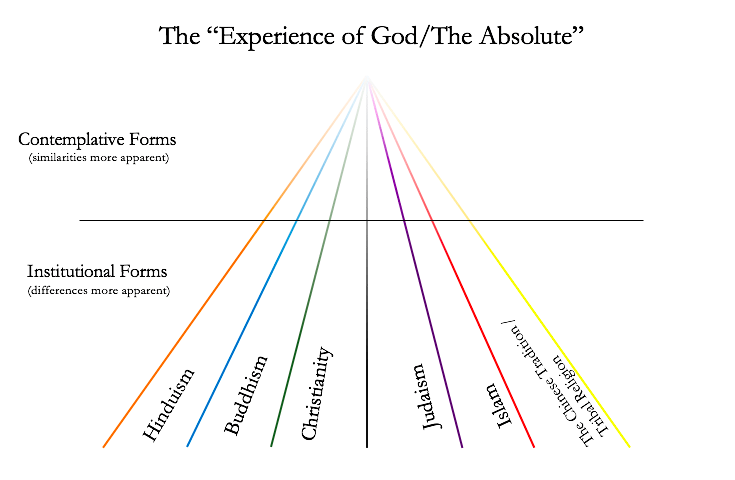
The notion of prisca theologia has been influential in the study of comparative religion, mysticism, and esoteric traditions. Writers such as Marsilio Ficino, Aldous Huxley, René Guénon, Frithjof Schuon, and Huston Smith have all explored the concept.
The purpose of this article is to outline perennial philosophy’s major components. What does it hold? These are some of the ideas you’d find in the work of Huxley and others. They are divided into the unities, the realities, the commonalities, and the practicalities.
The Unities
- Unity of Truth: One of the central tenets of prisca theologia is the idea that there is a fundamental unity underlying all religious and spiritual traditions. Huxley, Guénon, Schuon, and Smith would likely emphasize that despite the apparent diversity of beliefs and practices, there is a common core of truth or wisdom that runs through various faiths.
- Unity of All Being: Authors of the perennial philosophy emphasize the interconnectedness and unity of all existence. They argue that everything in the universe is interconnected and emanates from the same source
- Unity of Religion and Science: Some authors argue for the convergence of religious and scientific insights, seeing both as different avenues for exploring the nature of reality and existence
The function of the unities is to deny, or take a position against, various splits that are present in other religious or philosophical thinking. By “split” we mean here, some believe that science and religion are fundamentally opposed and cannot meet, or that they are two different systems of thought for different purposes. By unity here, we mean that this separation is not helpful to understanding reality better.
The Realities
- Primacy of Love and Compassion: Love, compassion, and selflessness are considered fundamental virtues in the perennial philosophy. They are seen as essential in one’s journey and in fostering harmony and understanding.
- Transcendental Reality: These thinkers would have highlighted the notion of a transcendent, unchanging reality that lies beyond the realm of the physical world. This reality is often referred to as the “Absolute,” “Ultimate Reality,” or the “Divine.”
- Primacy of Inner Experience: Huxley, Guénon, Schuon, and Smith might have emphasized the significance of direct personal experience in understanding the perennial philosophy. They would have stressed the value of spiritual practices, meditation, and contemplation as means to access the deeper layers of truth within oneself
The realities are statements of metaphysics, or what is so in the universe. Philosophies which would demote, or deny these realities would then be incompatible with the perennial philosophy.
The Commonalities
- Esoteric and Exoteric: The proponents of prisca theologia would have discussed the distinction between exoteric (outer) and esoteric (inner) aspects of religious traditions. They might have argued that the exoteric practices and teachings serve as symbolic representations of deeper spiritual truths accessible through the esoteric or mystical dimensions.
- Universality of Spiritual Truths: The perennial philosophy asserts that certain spiritual truths are universal and timeless, transcending cultural, historical, and religious boundaries. These truths are believed to be relevant and applicable to all individuals, regardless of their background
- Common Archetypes and Symbols: Perennialists point to the presence of common archetypal symbols and themes across diverse cultures and religions. These symbols are seen as reflections of the same underlying spiritual realities.
- Importance of Spiritual Practices: The perennial philosophy often encourages engaging in spiritual practices such as meditation, prayer, self-inquiry, and other transformative disciplines to cultivate inner awareness and connection to the divine.
While perennial philosophy has many different interpretations, most or all of them include the commonalities. Not all viewpoints agree on what the common archetypes and symbols are (or what they mean) but all seem to agree that there are common archetypes and symbols.
The Practicalities
- Role of the Intellectual: These thinkers would have considered the importance of intellectual exploration and scholarship in understanding and interpreting the perennial philosophy. Intellectual knowledge should be complemented by personal experience and spiritual practice to fully grasp the deeper truths, and to get at something akin to wisdom.
- Traditions: certain ancient wisdom traditions and philosophical systems that they consider to have preserved the core truths of the perennial philosophy. These traditions might include aspects of Hinduism, Buddhism, Sufism, Taoism, and certain mystical elements of Christianity and other faiths.
- Critique of Modernity/Materialism: Huxley, Guénon, Schuon, and Smith might have critiqued modernity’s materialistic and reductionist worldview, which often neglects or dismisses the spiritual dimension of human existence. They might have argued that the neglect of perennial wisdom contributes to various societal and environmental problems.
Finally, the practicalities tie to day-to-day life in society and how it flows, and how the perennial philosophy might be practiced.
Pluralism, not Relativism
Finally; perennial philosophy tends to be pluralistic. Religions are born in different places and times, with different mythologies tied to local cultural needs and understanding. If they lead to spiritual realization, they are valuable. But the might not all be created equal.
Everyone considers his own religion better than others’, but this is different than believing his religion is the only viable path. Stating that some systems may be better than others opens the possibility that different practices may be viable, but for example, inferior in a certain situation.
Relativism would be to say that all things are equal, one is as good as another, there are no real fair standards. Pluralism provides a perspective that can keep the good and discard the bad of a given faith tradition, without losing its core essence – the perennial philosophy.

