
People who write esoteric papers are constantly telling on themselves. Masonic researchers go down many different rabbit holes, each of them individual. I’m not here to claim I am right, papers such as these are in-progress term papers. They show what a person has learned so far, walking the path, with hopes it’s useful to others. Feel free to disagree with whatever seems unsound to you.
I have sought the truth in the desert, in cities, in the universities, in communities, and cloisters: I have sought it at the feet of the Pope who claims to be infallible, and found it not. At last I did find it – I discovered it within myself.
— Bishop Wilhelm Bedell, 1507
Introduction

A Hare was making fun of the Tortoise one day for being so slow. “Do you ever get anywhere?” he asked with a mocking laugh.
“Yes,” replied the Tortoise, “and I get there sooner than you think. I’ll run you a race and prove it.”
The Hare was much amused at the idea of running a race with the Tortoise, but for the fun of the thing he agreed. So the Fox acted as judge, marked the distance and started the runners off.
The Hare was soon far out of sight, and to make the Tortoise feel very deeply how ridiculous it was for him to try a race with a Hare, he lay down beside the course to take a nap until the Tortoise should catch up.
The Tortoise meanwhile kept going slowly but steadily, and, after a time, passed the place where the Hare was sleeping. But the Hare slept on very peacefully; and when at last he did wake up, the Tortoise was near the goal. The Hare now ran his swiftest, but he could not overtake the Tortoise in time.
It’s a true story. Of course it’s not literally true, tortoises and rabbits can’t talk. But we recognize elements of truth in it, like arrogance, focus, and hubris. We know how this story is true.
Freemasonry is said to be a “system of morality, veiled in allegory, illustrated by symbols”. Veiled in allegory means that Freemasonry is full of true stories whose truth is covered up by details not literally true. Freemasonry is full of “the tortoise and the hare”. There is not much historical evidence that the central character, Hiram Abiff, ever existed. There is a 1-sentence mention of a “widow’s son” Hiram in 1 Kings 7:13–14. Volumes of sacred law, are, generally, homes of parable and allegory.
The majority of masonic lore is missing from the historical record. But what of it? If there never was a position of Grand Junior Warden, this does not trouble most of us one little bit. You don’t need to believe in talking rabbits to see that the hare’s arrogance can be damaging.
How do we Teach Things that are Deeply True?
With these examples, we’ve created the idea of levels of truth. 2 + 2 = 4 is true, but “love is real” is still more deeply true. For math, we have schools. For things which are deeply true, our story, and that famous phrase about Freemasonry give us our first hints. We teach deeply true things with stories, with symbols; math has no need for allegory.
When we examine symbols and stories closely, they always contain correspondences: the rabbit corresponds to arrogance, the tortoise corresponds to patient effort. These correspondences and mappings are critical, so let us now move from children’s fables to spirituality.
Mysticism and Esoteric Schools of Thought
Freemasonry tends to attract men who are interested in many different schools. Much research has gone into the Hermetic Order of the Golden Dawn, Rosicrucianism, and many other schools of thought. The thing they all have in common is correspondences: namely, they create a set of mappings between ideas. One thing stands for another, and nothing means exactly what it is described as.
- The Worshipful Master stands for the rising sun. The opening of day, the plans ahead, and Wisdom.
- The Senior Warden stands for the setting sun, completion of work, and Strength
- The Junior Warden stands for the sun at noon, temporary rest, and rectitude of conduct (temperance, and the his jewel, the plumb)
- The three lesser lights are a correspondence
- The three degrees allude to youth, manhood, and old age
In any other religious, esoteric, or mystical system we would care to visit, portions of the system would be expressible as a set of mappings.
- The Kabbalah presents the Tree of Life, which maps circles/nodes on a tree into emanations of God such as wisdom and understanding
- Astrology presents the spheres of the heavens and their movements, and may variously map elements (earth, water, fire, air) to planets, or aspects of personality. Mercury, like its winged messenger god namesake, deals with communication, logic, and reasoning.
- Christianity represents a divine Trinity and maps familial relationships of Father and Son on to aspects of God.
Previously I gave one set of correspondences for the master and wardens, but you can read other books that have other, equally valid sets of correspondences from other traditions, for example to the signs of the zodiac. Symbols are simply shorthand for correspondences. If I refer to the symbol of the plumb, I am referring to the correspondence between the “upright straightness” of the plumb (which tries perpendiculars) and the uprightness of conduct Masonry recommends. If I refer to the symbol of the beehive, I am referring to the correspondence between the hard work of bees, and the conduct Masonry recommends.
In the study and understanding of correspondences, there are three traps:
- Spending too much time cataloguing all of the correspondences. The more you find and understand, the more you find there is another set right around the corner. Endless academic study and inventory of these systems is much like someone who wants to travel, spending months on end in a library studying maps.
- Getting sucked into arguments about who is right and who is wrong. Is the Worshipful master representative of Wisdom, or of the rising sun in the east? Or maybe of square conduct because of his jewel? If you are given two maps, one of New York and the other of Florida, you do not choose a destination and go any faster, by arguing which is right and which is wrong.
- Losing sight of the correspondence, and becoming literal. Are we to believe that one planet (Mercury) is a better communicator than another? Or that a leaf of a tree is God’s loving kindness? No, of course not. Hiram Abiff was a character in story, and rabbits can’t talk. Remembering Hiram Abiff as a teaching tool, one can say in a sense that all of these correspondences are true. We are not requesting belief in the literality of the correspondence, we’re looking for its useful insight. If they shed light on something abstract and underlying, they are deeply true.
We are here to go for something more fundamental. To do so, we have to communicate, and that turns out not to be as easy as one might believe.
The Limitations of Language
All communicated personal knowledge goes through a language and cultural filter that is mandatory. That filter may distort the knowledge, and must be understood and accounted for.
We have to use stories because descriptive language is not good enough. We might consider programming people instructions; good moral maxims, like do not lie, help others, and so on. We might try to build better people like an Ikea cabinet. Yet it is not done this way; we find the same allegory, symbol, and correspondence approach to teaching truth, if we go to 1st century Buddhist texts or 21st century western neo-mystical writing. We cannot morally program humans because there’s no language to do so. The objective is to create an internal transformation, and that is so abstract that instructions will not do.
So we do not instruct effectively by saying: “do this”, but by telling a story, and saying “what we are looking for is like this”. We have to go through this comparison layer because you cannot directly encode internal states, to communicate is to go through sense perceptions and direct experiences.
We have only sense perceptions of sight, hearing, taste, touch, and smell as ways to get information into us. Because these are the way we get information about the universe, language tends to describe abstract ideas, emotions, and internal states in terms of comparisons to physical percepts:
- Your headache may be dull and pounding (touch)
- A business deal about to go south might not smell right (scent)
- You can feel bitter towards an ex-girlfriend. (taste)
These turns of phrase are not incidental. People relate hard things by mapping them back to familiar sense perceptions, because we share those, we all know what bitter taste is, and the listener is asked to imagine something that feels like bitter tastes. We work around the inadequacies of our language. These sense perceptions are like the primary colors of experience; and can be complex. I can tell you a piece of music was smooth like silk. I’m not trying to be poetic, I’m trying to communicate something about an internal state, or what I feel.
Internal states, and phenomenology is important to transmit the moral information that Freemasonry, esoteric, and religious systems bear. It’s why church might contain chanting, candles, and incense. It’s why you didn’t wear your own pants at your Entered Apprentice degree. Knowing information is not enough, one has to feel that it’s right, and align brain and heart in order for the message to arrive. Even a criminal who won’t confess “knows” what he did was wrong.
Knowing with the brain is flatly not enough.
So it is possible that everyone may yet find within himself that Word which is the truth. When we shall have found it, we will not publish it – broadcast throughout an unreceptive world, any more than our ancient fathers did in bygone ages.
George Plummer
Given how weak English is, esoteric systems face enormous communication challenges. If a mystic wished to create in your mind the feeling of God’s love, he might say something imaginative, like “sunlight, brighter than you’ve ever seen, entering the top of your head, and slowly filling your entire body”. And the source of all of this light, a powerful symbol everyone can picture in their mind’s eye: The Sun. And a correspondence: God is like the Sun. Mystics who know the truth cannot communicate it. And so different people at different times will come up with various correspondence systems to encode knowledge that can not be spoken in regular words.
We are always operating below the surface layer. We do not believe there is a hole at the top of your head that admits sunlight; Hiram Abiff wasn’t a real man, and rabbits can’t talk.
Plato’s Cave
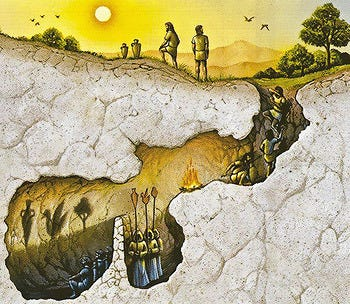
To convey moral information requires feeling, but language isn’t enough to do the job. So we layer on symbols, correspondences, and allegory to get at a certain reality. We are not capable of speaking about our internal realities, we’re talking around them, as best we can with the limited tools we have.
People have been thinking about this for thousands of years. Plato’s Allegory of the Cave describes a group of people who have lived chained to the wall of a cave all their lives, facing a blank wall. The people watch shadows projected on the wall from objects passing in front of a fire behind them and give names to these shadows. The shadows are the prisoners’ reality, but are not accurate representations of the real world. The shadows represent the fragment of reality that we can normally perceive through our senses, while the objects under the sun represent the true forms of objects that we can only perceive through other means.
The mystics, the degree systems, and all of that esotericism is in the same situation. To spend all of one’s time studying the degrees would be like sitting against the wall, watching the shadows dance. These shadows are important – and true – reflections of reality, and not to be dismissed. But the point isn’t merely to enjoy the show, but to act on the truth of its contents. Freemasonry makes this about as clear as any initiatic or symbolic system could. One’s Masonic mentor might tell them:
We are going to give you a set of working tools, which you will apply with the skill of a master craftsman, in the quarries of your life. Masonic ritual contains its own escape instructions. Don’t spend all of your time admiring the wording of the 24″ gauge speech, this would be like sitting against the wall watching the shadows dance. Get out there and get to work.
The Arbitrary-ness of it All
A puzzle in Freemasonry that is worthy of careful consideration is this: we admit that it is not in the power of any man, to make innovations in the body of Freemasonry. And yet we will learn of the dozens of different traditions and rites in Freemasonry. We’ll learn that the Master Mason degree was added at a later date, the Hiramic legend was version 2 after an earlier Noachite legend, and that Grand Lodges were a practical invention along the way. In 1843, the Baltimore Convention standardized ritual and decided all business would be done in a Master Mason’s lodge, a big change for many jurisdictions. Today, our Grand Lodge is in amity with other jurisdictions whose practices would never be allowed here. We understand that they too practice true Freemasonry, as painstakingly verified by many thoughtful masonic legal processes.
So much change, and yet obviously no innovation. That is the puzzle. What does it actually mean that those other jurisdictions practice true Freemasonry, when it is different than ours? What shifts through the years, and what remains fixed? This is a puzzle within Freemasonry, but also outside of it: Freemasonry is one system, but there are dozens. Many of which have helped other men improve themselves. If we’ve got the right answer, how could it be, someone else is also right, and yet does things so differently?
For this, we need the semantic triangle, consisting of sign, reference, and referent.
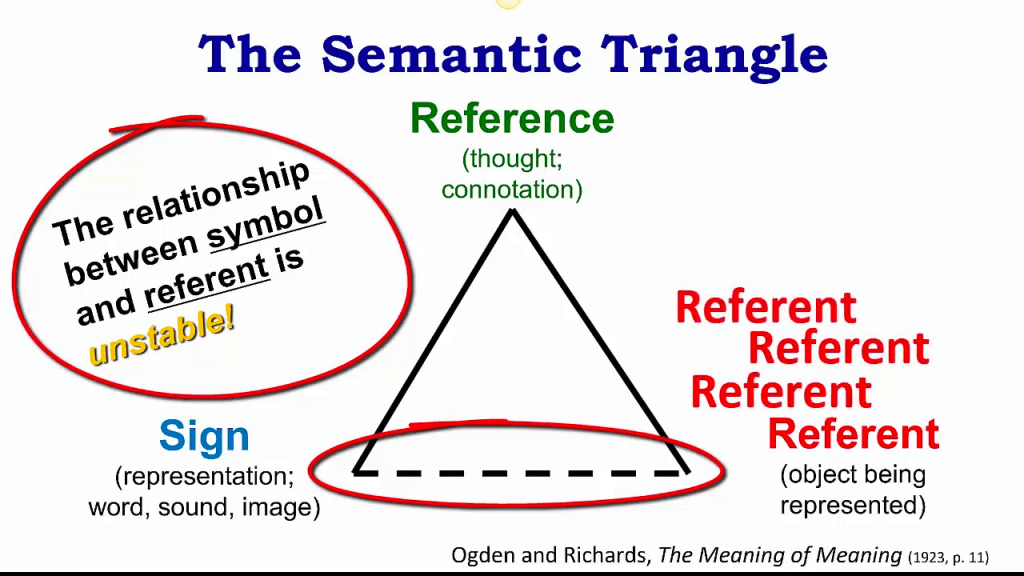
Explained with an example:
- The term “orange” is a sign or symbol.
- The reference is what’s created in your head when I say the word.
- And the referent is the real thing in the real world, a round, ripe orange.
They form an unstable triangle, because the relationship between the word orange and the real world thing can and does change. The word could be different, and what’s created in your head by the word may also be different, depending on how you were raised. A different word (sign), arriving in a different mind (reference) – the truth of the orange (referent) would remain.
Applying this to Freemasonry, we know that if Mexican Freemasons use Spanish “signs” for the working tools, this should not bother anyone. We know that when a UK mason pictures a square in his mind, his “reference” is different from the traditional US square. Going from words to practices, we know that in North Carolina, lodges take up a word in an EA lodge. In Virginia they do not. The practices / collections of signs changed. The references changed. The referent (internal state being taught) did not. Yet we can go further with this idea.
How can this be, that practices widely vary, that innovation is not possible, and that they’re all practicing the true Freemasonry? It comes from the recognition that the deeply true parts of Masonry are intact, and still true. Hiram Abiff was never a real man, so if he’s left-handed in some districts, or does his daily exercises in reverse order around the temple, the story is still true. The York Rite and the Scottish Rite have major allegorical story disagreements on topics such as what happened to the ruffians. Why is neither group wrong? Despite the disagreements, there is no discord, because we recognize they’re all masons working on different parts of the same temple, toward the same goal. What they’re doing is true, let’s not get hung up about whether rabbits can talk or not.
It is humbling to consider that some of these story lines, symbols, and details are effectively arbitrary; they could be just about anything. We shouldn’t take this too far though and claim that the specifics of the symbols don’t matter, because they do. The specifics are cemented into our social structures by historical tradition. Tradition is that a certain round citrus fruit is called an “orange”. I could invent my own word, “pelobob” to refer to the same thing. People have done just this with God, the Great Architect of the Universe, Ram, Allah, Adonai, and so forth. To be a member of a particular society, I’d stick with “orange” and not invent another word, if I wanted to get along with others. There were long historical evolved reasons why that conclusion was arrived at, and though it might be arbitrary, that does not mean that any random substitution would be just as good.
To be a member of Freemasonry, it becomes useful to accept the system and vocabulary of symbols. Freemasons refer to “The Great Architect of the Universe”, never as Adonai. Fair dealing is “square” not “fair”. We are not free to substitute stone building metaphors with carpentry metaphors; (though similar lessons could be taught with wood), because this is our shared vocabulary. Freemasons have one, other practices do too. Using different models and metaphors, so long as they pointed to the same deep truth, would likely yield similar results.
Imagine an alternate universe of Ancient Free & Accepted Carpenters, who taught removal of a person’s personal flaws with the “wood plane”, and who taught friendship and brotherly love with the lesson of the dovetail joint. Would they be bad men? How different would their truths be from those of Freemasonry?
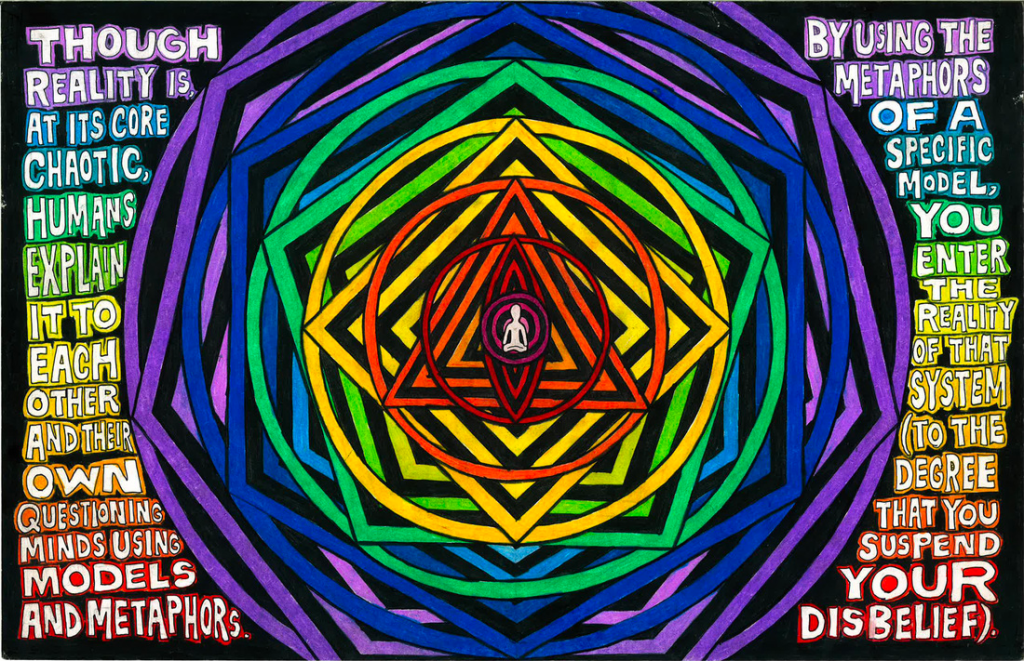
Though reality is at its core chaotic, humans explain it to each other and their own questioning minds use models and metaphors. By using the metaphors of a specific model, you enter the reality of that system (to the degree that you suspend your disbelief)
— Remember, by Wanderweird
An Incomplete Reality

Consider a deity that was entirely beyond words, awe-creating in his impact on humans. A deity so hard to conceptualize that in some traditions, his name could not even be said or pronounced. Take this as a constant, throughout all time. Now consider that humanity has been everywhere for a few hundred thousand years, in different cultures and life situations, ranging from hunter-gatherers to war-torn agrarian societies, to high-tech billionaire investors.
These cultures and peoples would be like the group of blind men who had never come across an elephant before and who learn and imagine what the elephant is like by touching it. Each blind man feels a different part of the elephant’s body. One blind society feels a tusk and describes God like a vengeful spear. Another blind society experiences a large strong leg and describes God as a pillar of strength. They might even end up going to war over the differences, if they get loud enough in their disagreements!
And so it goes. In each time and place, societies fumble with the limited words, tied to sensory perceptions. They set up new correspondences, and tell a new set of stories about their heroes and their deeds. All encoding the same basic deeply true things such as what we call “acting on the square”. We can be sure that hunter-gatherers and subsistence farmers didn’t like being cheated any more than billionaire investors like it. Whether loincloth or $1,000 blazer, fairness is a universal, and the society will be interested in that value. The same is true for love, honesty, and many other abstract internal states.
Various cultural encodings gave rise to Islam, Hinduism, Christianity, Judaism, and many other besides. Different people, languages, cultures, and time; none of the early founders were crazy, they were all feeling the same thing. In a sense they can all be recognized to be true; “the religion of the front-half of the elephant”, or, “the religion of the left side of the elephant”.
If God is infinite and ineffable, then it may not be possible to have a religion of the whole elephant. If there were, it would be bizarre and would contain elements well outside of your cultural context & understanding. And even if it were possible, we wouldn’t be able to speak it. If your holy scripture is the word of God, he hasn’t said everything; he can say more whenever he pleases.
So we might say that all religions are incomplete, in the sense words cannot capture the full picture. And every religion may also be complete, in that it provides a cohesive enough set of signposts, that a motivated seeker can get to the truth if they apply diligence & time.
Perennial Philosophy
If you look at all the traditions that arose independently of each other, and some of the things they say overlap, the likelihood that those things are true is quite high.
Prisca theologia, also known as the “perennial philosophy” or “perennial wisdom,” is a concept that suggests there is a universal and timeless core of spiritual truth or knowledge that underlies and unites all major religious and philosophical traditions. The term “prisca theologia” is Latin for “ancient theology,” reflecting the idea that this essential wisdom has been present throughout human history and across various cultures.
According to proponents of the perennial philosophy, while different religious traditions may have distinct beliefs, rituals, and practices, there exists a deeper, fundamental understanding of the nature of reality, the human condition, and the divine that remains constant across these diverse expressions. This universal wisdom is said to be accessible to all individuals, irrespective of their cultural or religious backgrounds, and it provides insights into the nature of existence, morality, and the ultimate purpose of life.
Prisca theologia/perennial philosophy is a form of syncretism. Syncretism is the mixing and matching that humans do of cultures and ideas, and it has been around as long as humans, whenever different worlds were colliding in the intellectual sphere. The more interchange there is between different kinds of peoples and ideas, the more humans will try to reconcile all of those ideas into a consistent whole.
probably first used in the early Renaissance by Florentine scholar Marsilio Ficino (1433-1499) (…). It was fundamentally a movement by para-pagan Renaissance philosophers and magicians to attempt to legitimize and Christianize a series of pagan books that they believed contained authentic philosophical and magical wisdom. Although the list of the philosophers and texts of the Prisca Theologia varies, it generally includes Zoroaster (Chaldean Oracles), Hermes (Corpus Hermeticum), Orpheus, Pythagoras (Golden Verses) and Plato. The essence of the movement was the syncretistic Christianization of pagan philosophy, magic, astrology, alchemy, theurgy, etc.. (One can see these ideas reflected in Raphael’s marvelous painting the “School of Athens.”)
>
More broadly, several early Christian theologians (e.g. Clement, Origen, Augustine) also believed that contemporary (neo) Platonic philosophy was largely compatible with Christianity. Plato, through reason, taught the same truths as the biblical Prophets taught by revelation. This movement seems to have begun with the Alexandrian Jewish philosopher Philo, who attempted in his massive works to show that the Bible and Plato taught essentially the same fundamental doctrines. In another sense, the attempts of medieval scholasticism to synthesize Aristotle and Arabic philosophy with Christian theology reflect this same tendency.
Hamlin
There have been many such syncretic time periods throughout history. The Library of Alexandria was prized as being an intellectual cross-roads, and was much more valuable for being so. More recently in our lives, the 1990s brought much discussion about globalization and about how the world was becoming smaller. Travel and internet made it easy to see what the other side of the world was thinking about, and English being adopted as a common language drastically increased the information exchange between regular people. This affect impacted all fields of human thought, but naturally also spiritual and esoteric thought.
The 21st century then is another instance of worlds colliding, and so much discussion of the perennial philosophy comes up again. As people’s experience expands, they integrate more knowledge into a consistent whole.
Freemasonry and the Perennial Philosophy
We are now at the bedrock constancy of Freemasonry. The parts of the elephant we’ve all been describing for the last few hundred thousand years since humanity acquired language. God is god, loincloth or $1,000 blazer, the absolute referent.
At the core of Masonic stories, there is acknowledgement he had the same perennial philosophy as we do today. If Hiram Abiff had been a real person, we know he would have been Jewish. Freemasons can admit men of all faiths, why? This is an extraordinarily wise and admirable aspect of Freemasonry; ecumenicalism, born out of age of Enlightenment. Because at the core there is an acknowledgement that they are doing the same as us, trying to move closer towards the same deep truth.
So that you know this is Masonic and not just this author’s opinion, notice that taking Masonic obligations on different volumes of sacred law is specifically permitted. The first of the three great lights in Masonry can vary. We ask candidates if they profess a belief in a higher power, and when they say yes, we apply no further ideological purity tests. Because we know that some men will worship the tusk God, and others the leg god.
Those points are enormous, and fundamental in their significance, and if they were to change, would be the purest form of innovation wise leaders should not permit.
The perennial philosophy is just a name. It is what we call the fundamental sameness in all volumes of sacred law. The perennial philosophy is another “stable referent” of the semantic triangle. It is the constancy, despite how arbitrary our stories are. Signs and references will change, the referent does not. Some people believe “everything’s relative”. Others believe in absolutes. I think they’re both right: signs and references are all all relative: to the referent. The referent is absolute.
Conclusion
The purpose of this paper has been to pull on a thread that connects the study of many different esoteric areas, and see how they are connected to Freemasonry. We have suggested how it might be that all the various faiths are connected, and why specifically they are all acceptable. Because God is an Elephant, and all of our various human cultures are like blind men describing what they feel.
We have discussed levels of truth, and how this is conveyed despite language’s limitations, through correspondences. This author does not actually believe that God is an elephant, but adopting that view, for this paper, we hope sheds some light on the situation we find ourselves in.
Perennial philosophy is the thing we are trying to shed light on, at the end of the day. It is some universal, stable set of truths recognized in many places & times, with different language.
Finally, Freemasonry without words, implicitly acknowledges something akin to a perennial philosophy, and accepts men of all faiths. The most fitting way to end this piece is with a quote from the Constitutions of Freemasonry, showing the good effects of this stance:
hereby Masonry becomes the Center of Union, and the Means of conciliating true Friendship among Persons that must else have remain’d at a perpetual Distance
May brotherly love prevail, and may every moral and social virtue cement us.
References
Plummer, George Winslow. The Master’s Word: A Short Treatise on the Word, the Light, and the Self. Annotated by Robert H. Johnson and Jon T. Ruark, WCY Media, 2021.
McEvoy, Norm. “The Spiritual Interpretation of the Officers of the Lodge“, September 2016.
Noachite Legend and the Craft, Square Magazine. February 2021
The Constitutions of Freemasonry
Hamlin, William. “What is Prisca Theologia?“, 2013.
REMEMBER. A meditation by Wanderweird, (date unknown)
 Forthright
Beautiful article. Thank you for sharing.
LikeLike
thank you
LikeLike